.webp?language=en)
News & Market Insight
Geopolitical Risk Reshapes Project Logistics
_3.jpg)
By Amy McLellan
As geopolitical fault lines continue to reshape global trade, discussions at Breakbulk Europe frequently returned to the challenges of war risk, insurance volatility and supply chain resilience.
Tina Benjamin-Lea, senior project logistics manager currently on assignment at Lilly and moderator of the Geopolitics in Action panel session, pointed to some sobering numbers: It was now the 939th day of the Red Sea challenges, the 108th day of the Persian Gulf crisis and the 1,573rd day of the issues in the Black Sea.
The panel in Rotterdam agreed these were challenging times but, as Sofie Lemlijn, head of marine, cargo and logistics at Marsh Risk, pointed out, it is not the first crisis the industry has navigated. “The sector is used to it and very agile,” she said. “However, it still is a surprise what comes next, because the world keeps surprising us.”
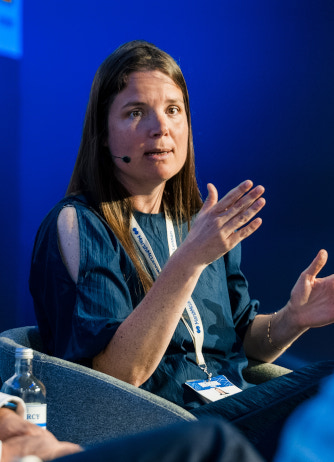 Many companies are now rewriting clauses in response to the serial crises that have hit the industry in recent years. The challenge, according to Lemlijn, is when those clauses have to be interpreted in the light of a new reality. “You constantly need to adapt to the new situation and remain in dialogue with all the partners in order to find a common reading of the clauses and then learn and adapt going forward,” she said.
Collaboration is essential in finding solutions and keeping trade moving during these challenging times. “Every company needs to make a profit but, in my opinion, as a sector we always did a very good job at putting partnerships above costs,” she said.
Patrick Richardson, global key account manager for AsstrA-Associated Traffic, said flexibility is important. “Our customers want to keep the cargo flowing, and so if you cannot pass by sea, then we look for alternative solutions,” he said. “When the cargo becomes really too large or too heavy, then you have an issue. But that's what we are there for, working together with our customers, to look for solutions and address this.”
He added that it’s important not just to react to events but also to be proactive. “We see our customers doing this much more too,” he said. “When they are planning for their projects, they want to investigate the contingency route, the alternatives, and they are involving us more and more, so they have a plan B available in advance, much earlier in the project.”
Wim Copmans, regional director of projects and heavy-lift cargo, Europe at PSA BDP, agreed, noting that price is no longer the prime driver of business. “It’s still a factor, but more and more we see customers also looking for resilience and for a good backup plan and partnership with us,” Copmans said.
This matters because geopolitical crises tend to have downstream impacts that can be hard to predict. “When you have disruption somewhere, you will always have ripple effects throughout the entire market,” he added. “It’s difficult to anticipate in advance, where these imbalances will emerge, and that can be challenging to get the customer to understand those wider impacts.”
Of course, project logistics is not just about cargo; it’s also about people, particularly seafarers who often face dangerous situations or extended periods at sea due to blocked shipping lanes or lengthy rerouting.
“That is sometimes what is a little bit forgotten,” said Dr Martin Harren, owner and CEO of Harren Group, pointing out that the disruption and risk that comes with geopolitical crises hits seafarers the hardest.
And this has implications because it is getting harder to recruit and retain crews. After all, as Tina Benjamin-Lea pointed out, “without the seafarers our cargo wouldn’t move.”
Top photo (L-R): Tina Benjamin-Lea, Martin Harren, Patrick Richardson, Wim Copmans, Sofie Lemlijn. Credit: Richard Theemling Photography
Second: Sofie Lemlijn. Credit: Richard Theemling Photography





-507b27cb-e01a-4904-a354-12022e1ecb2c.webp?language=en)
















-5f4c3bc3-7307-4be5-a07c-550729e3af81.webp?language=en)



-0132863b-967b-4157-a7c7-6f00bf715c8e.webp?language=en)





-ce89ba57-0fcf-44c7-85d1-fa6c83593803.webp?language=en)
















-788e1668-d470-4275-a79b-9e22329fc719.webp?language=en)