.webp?language=en)
News & Market Insight
Collaboration Critical to Meet Wind Challenge
_3.jpg)
By Simon West
Collaboration between ports, contractors and developers will be critical if Europe is to overcome looming capacity constraints and deliver ambitious offshore wind targets, industry leaders said during a panel discussion at Breakbulk Europe.
Offshore wind has emerged as one of the most promising growth markets for project cargo, but ports face mounting pressure to prepare for what session moderator Patrick Walison described as a “huge installation peak” for fixed and floating facilities after 2030.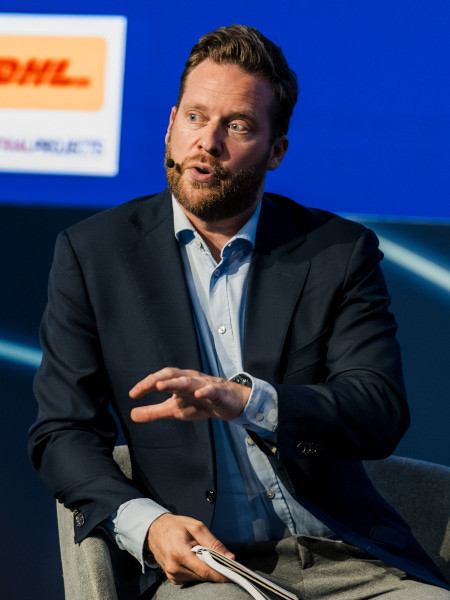 Walison, senior consultant of maritime strategy and economics at Haskoning, warned that rapidly changing technical requirements, uncertain project pipelines and intense competition for scarce waterfront space are creating a widening mismatch between industry goals and available infrastructure. “We see an increasing gap between the targets, the ambitions and the projects, and available port capacity,” he said.
Tom Saelens, lead category manager of logistics at DEME Group, agreed the sector was heading toward a significant capacity crunch as deployment continues to outpace the ability of ports, contractors and the wider supply chain to keep up.
The problem, Saelens said, is being compounded by ever-larger turbine components, which can only be handled by a shrinking number of ports. As activity becomes concentrated at a handful of specialist hubs, bottlenecks are likely to intensify. Greater standardization of turbine sizes could help ease pressure on ports and supply chains in the years ahead, he said.
“We need to work together with ports, with the developers, to make sure that we have the best solution. Otherwise, things will become more and more expensive,” Saelens said.
Jelle Schepens, senior ports manager of turbine maker Vestas, agreed that rapidly growing turbine sizes are placing unprecedented demands on port infrastructure. Longer blades, heavier nacelles and other components require more space, stronger quaysides and specialized handling facilities, often beyond what existing ports were designed to house.
Schepens argued for closer collaboration between ports and developers to ensure future infrastructure is built to meet the specific requirements of offshore wind.
Saelens said contractors such as DEME already engage with ports at an early stage to better understand capabilities and future expansion plans, helping to identify infrastructure gaps before projects move forward. But he acknowledged the challenge for ports in justifying major investments based on offshore wind projects that may not materialize or could ultimately be handled elsewhere. A solution, he suggested, could see ports within a given region working more closely together.
Paul Hatley, lead commercial manager at Associated British Ports (ABP), the UK’s largest port operator with 21 ports across England, Scotland and Wales, said upgrading infrastructure was a key challenge. Much of APB’s estate dates back to Victorian times, meaning the conversion of quays, locks and other facilities from traditional cargo handling to offshore wind operations requires significant investment.
“It’s doable, but it comes with quite a high cost,” Hatley said. “The consenting side of it is important: Early engagement with potential customers and suppliers is crucial.”_2.jpg) Hatley noted that APB’s extensive land holdings provide opportunities for redevelopment. Several former fishing ports have already been repurposed to support the energy transition, including Grimsby, where the eastern side of the port has been transformed into an operations and maintenance base for offshore wind projects.
Hatley noted that APB’s extensive land holdings provide opportunities for redevelopment. Several former fishing ports have already been repurposed to support the energy transition, including Grimsby, where the eastern side of the port has been transformed into an operations and maintenance base for offshore wind projects.
Jerry Hallisey, head of business development for Shannon Foynes Port Company (SFPC), Ireland’s largest bulk and breakbulk port and second largest overall after Dublin, also said land was no issue, with the company currently identifying 3,000 hectares of land for potential port-related activity and energy infrastructure.
Ireland is targeting 4.5 gigawatts (GW) of offshore capacity by 2032, rising to 14.5 GW by 2040 and 37 GW by 2050, with the vast majority expected to come from floating wind projects. To prepare for the rapid growth of floating offshore wind in the Atlantic, SFPC has already joined forces with APB and Brest Port in France through the Global Wind Ports Alliance.
The lack of financing certainty, though, is hampering port spend across Europe, even as offshore wind ambitions accelerate. Port operators face the challenge of committing to costly infrastructure projects years before demand is guaranteed, prompting calls for closer collaboration between governments, developers and ports to help de-risk investments and unlock the capacity needed for future growth.
Top photo (L-R): Jerry Hallisey, Tom Saelens, Paul Hatley. Credit: Richard Theemling Photography
Second: Patrick Walison. Credit: Richard Theemling Photography
Third: Jelle Schepens. Credit: Richard Theemling Photography




-507b27cb-e01a-4904-a354-12022e1ecb2c.webp?language=en)



















-5f4c3bc3-7307-4be5-a07c-550729e3af81.webp?language=en)



-0132863b-967b-4157-a7c7-6f00bf715c8e.webp?language=en)







-ce89ba57-0fcf-44c7-85d1-fa6c83593803.webp?language=en)
















-788e1668-d470-4275-a79b-9e22329fc719.webp?language=en)